Harbor Lane Coffee is an invented brand on a Shopify development store. I built the retention and conversion work that Shopify brands keep hiring for, then checked each piece with a script or a real test order: Klaviyo flows, an A/B test with a sample-size plan, a 301 redirect map, a coded Mailchimp email and GA4 purchase tracking.
Demo store: no real customers, orders or revenue. Everything here is verified behaviour, not business results.
My Shopify proof was custom Liquid themes. When I read the Shopify job posts I was screening, the same gaps kept coming up: Klaviyo, A/B testing, Shopify CLI, CRO and the Admin GraphQL API. Upwork posts add three paid problems on top:
Klaviyo flows that misfire: generic cart reminders, or "you forgot something" emails sent to people who already paid.
Re-platforms that lose Google traffic: WooCommerce uses /product/, Shopify uses /products/, and every old URL needs a 301.
GA4 that sees traffic but no purchases: since Shopify moved checkout to extensibility, old checkout scripts no longer fire.
So I built a coffee store with a real catalogue and solved each of these on it. The rule for the project was that nothing counts until a script or a test order proves it.
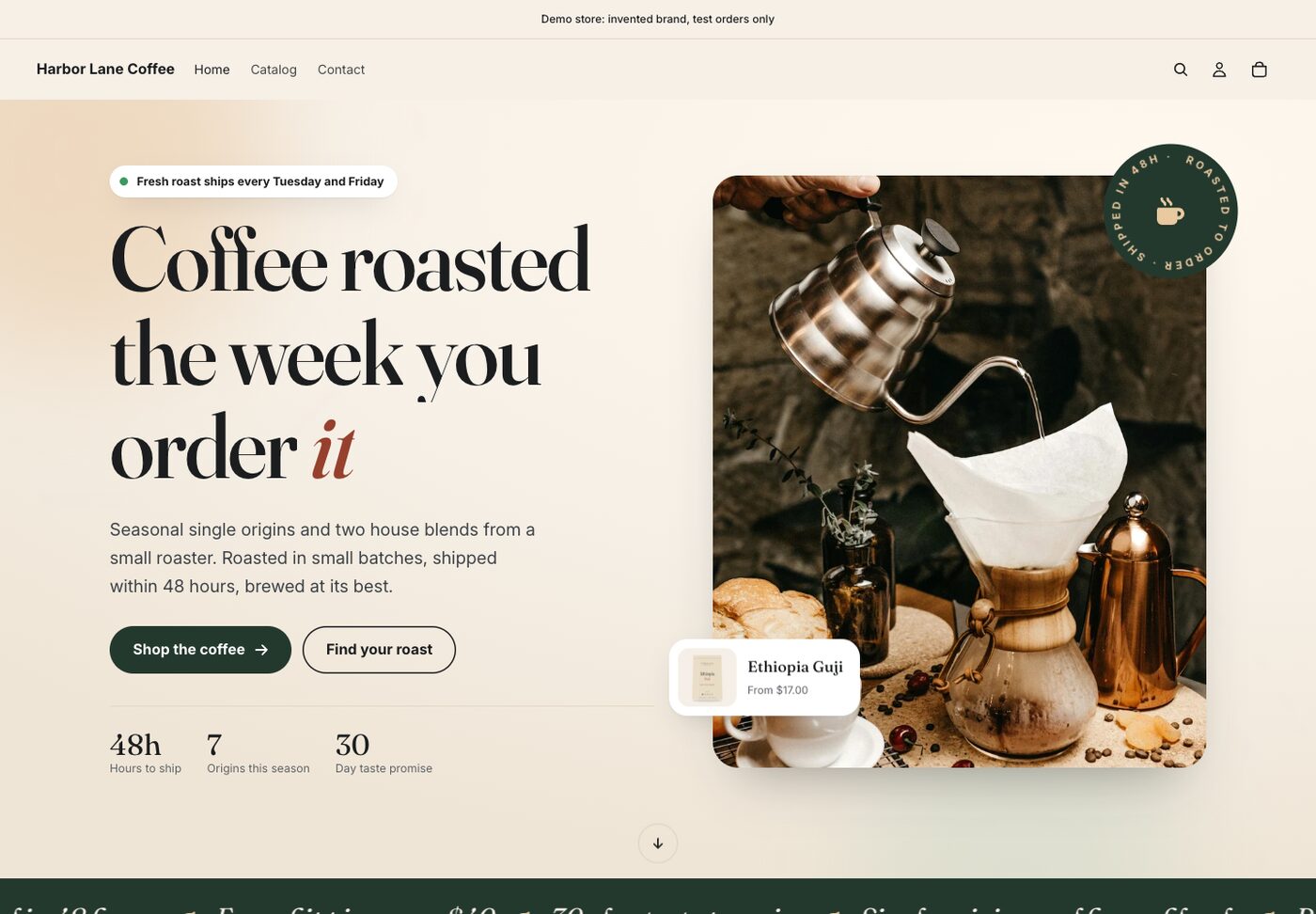
harbor-lane-coffee · demo store
Custom Online Store 2.0 sections on Horizon. The client's brand stays the client's.
02 / What I built
Six pieces, each with a check.
1. Klaviyo: three flows that know who already bought
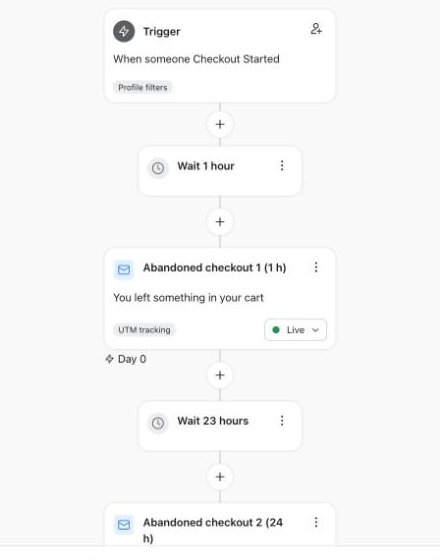
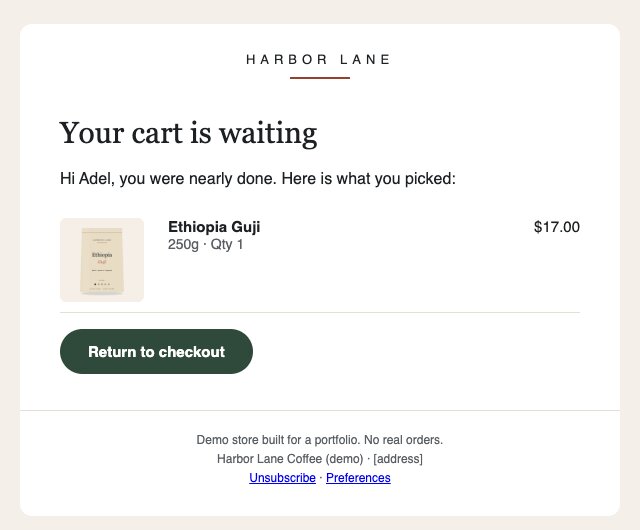
Abandoned checkout: emails at 1 hour and 24 hours with the real cart (image, variant, price) and a return link. A flow filter removes anyone who places an order after starting the flow.
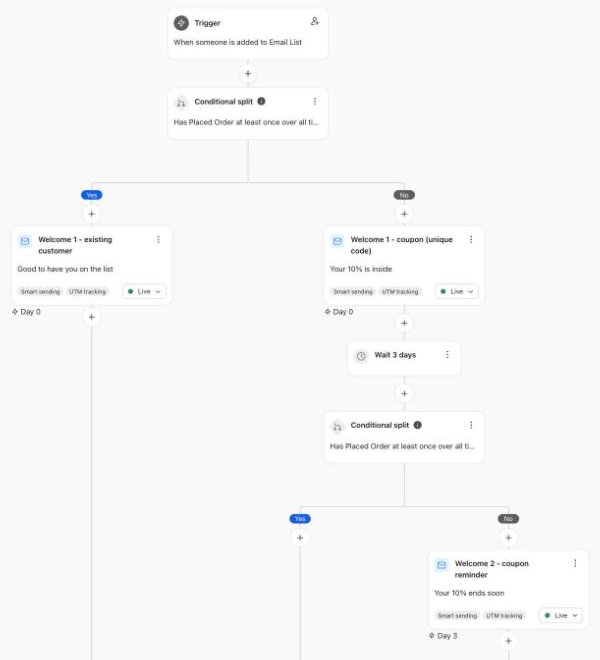
Welcome: a split sends existing customers a thank-you and new subscribers a unique 10% code (prefix WELCOME-, expires after 7 days). After 3 days a second split re-checks for an order before any reminder goes out.
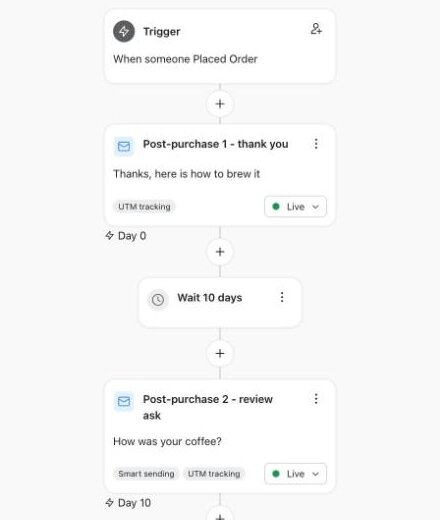
Post-purchase: a brewing guide straight after the order, and a review ask on day 10, once the coffee has arrived.
A popup and a footer form, two segments ("Engaged 30 days", "Bought once") and 8 coded templates. The flows are defined in code through Klaviyo's API.
welcome
abandoned checkout
post-purchase
Tested with a real checkout
A test shopper started checkout and paid with Shopify's test gateway inside the hour. Klaviyo recorded every step from product view to order. The post-purchase email arrived 1 minute after the order, and the abandoned flow sent nothing, which is exactly what it should do.
email 1 · rendered from the real checkout
2. A/B test, set up properly
Shopify Rollouts isn't available on development stores, so the split runs in the theme. Variant B shows a quick add button on product cards.
A hypothesis, one primary metric (sessions with an add to cart), and a 50/50 cookie split that sticks across visits.
A QA override, exposure events, and the variant saved on the cart and sent to GA4, so it follows the customer into checkout.
Sample size before launch: at a 7% baseline and a +10% lift, the test needs 21,815 sessions per variant. At 1,000 visits a day and a 7% baseline, a fair test of a +10% lift takes 7 weeks.
Check (78 simulated sessions)
Result
Errors
0
Split A / B
39 / 39
Correct page for the variant
78 / 78
Same variant after reload
78 / 78
Cart attribute matches variant
78 / 78
3. Redirect map for a re-platform
I mapped 30 old WooCommerce-style URLs (products, categories, tags and pages) to their new Shopify addresses. The redirects were created through the Admin GraphQL API and also exported as Shopify's CSV import file. A checker requests every old URL with and without the trailing slash, then confirms one 301 hop to the right page, which answers 200.
$ python3 redirects/check_redirects.py
/product/ethiopia-guji-single-origin
301 -> /products/ethiopia-guji ok
/product/ethiopia-guji-single-origin/
301 -> /products/ethiopia-guji ok
/product-category/coffee/single-origin
301 -> /collections/single-origin ok
/about-us
301 -> /pages/about ok...
60/60 passed
Finding: Shopify serves /shop itself, and URL redirects only fire on a 404, so /shop can't be redirected. Old links to it have to be fixed at the source.
4. GA4 purchase tracking through Customer Events
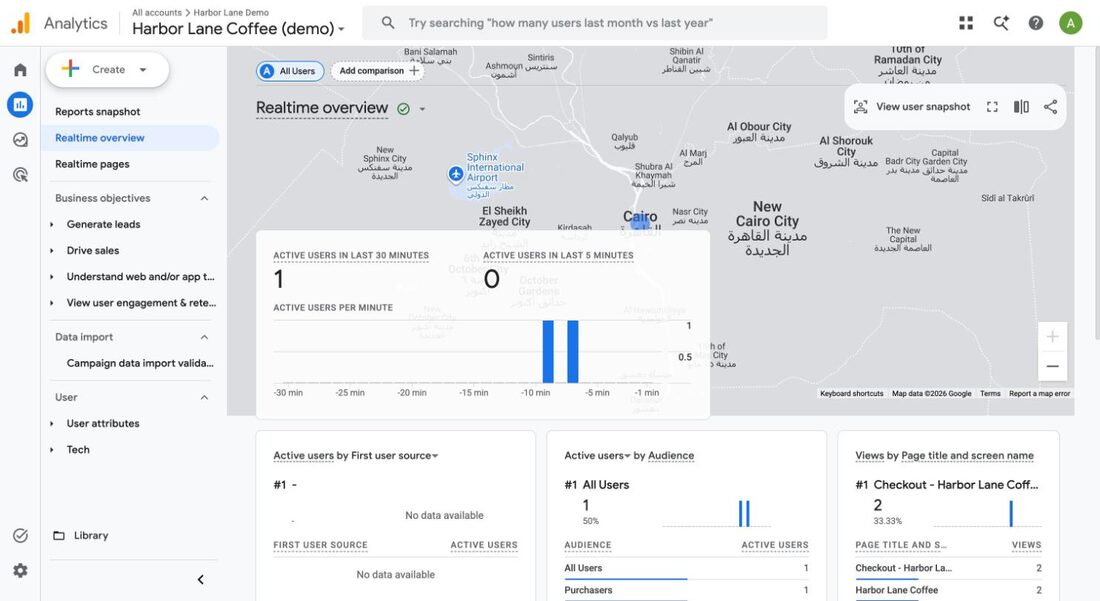
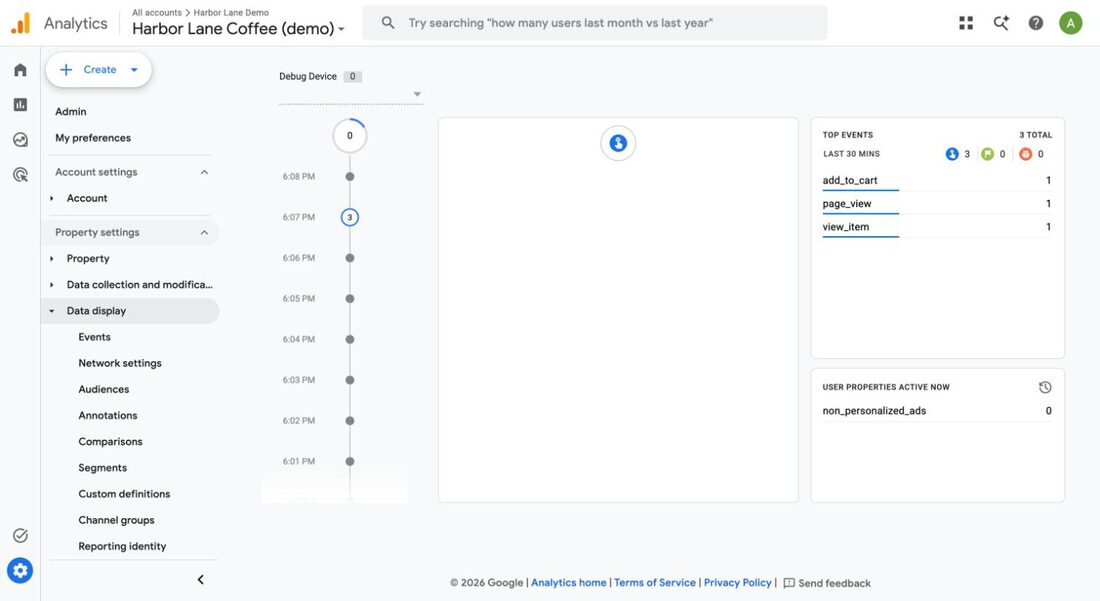
A custom pixel sends view_item, add_to_cart, begin_checkout and purchase. Each event carries its items and the A/B variant. I verified it in GA4 Realtime with a real browser and the test order, and the purchase counted as a key event.
GA4 realtime
GA4 debugview
Three findings worth knowing if you set this up:
GA4 Enhanced measurement sends extra page views from inside Shopify's pixel sandbox, using the frame's URL. Turn it off and let the pixel send page_view.
Inside the sandbox, debug_mode on the config doesn't reach the events, so DebugView stays empty. Set it on each event.
GA4 drops headless-browser traffic. Scripts can prove what the pixel sends, but only a real browser proves what GA4 receives.
5. Theme sections that help people buy
Seven custom sections and three blocks on Horizon, all editable in the theme editor: quick add, sticky add to cart on mobile, a roast picker (accessible tabs), a roast meter, a brew calculator, and trust badges next to the button. Mobile Lighthouse medians on the live theme: home 89, product 88, collection 84. These are lab numbers from a shared dev-store host.
6. A hand-coded Mailchimp email
A 600 px table layout with inlined CSS and merge tags, imported as a custom-coded template, test-sent, and checked on desktop and phone. On the free plan you can import, preview and test-send it. Sending a campaign with it needs the Standard plan.
03 / Results
What was proven, and what wasn't.
Piece
How it was checked
Result
Klaviyo flows
Test profiles and a test-gateway order
Events received · post-purchase sent in 1 min · abandoned flow correctly silent
Email templates
Klaviyo's renderer and a real send
7 / 7 render with every tag filled; the coupon email (unique codes only exist on a real send) was delivered to a test inbox
A development store has no real visitors, so there are no conversion or revenue results here. The A/B test is built and checked with simulated sessions; a real result needs a store with enough traffic, and the sample-size table says how much. Emails went to my own test inboxes only.
04 / What I'd do next
Where it goes from here.
A checkout UI extension on the same store, to cover checkout extensibility.
Browse-abandonment and winback flows, plus SMS when there's a sending number.
Server-side tracking on top of the Customer Events pixel, with event IDs to remove duplicates.
On your store, the same work becomes fixed-scope jobs: a Klaviyo flow audit and fix, a redirect map with a checker for a re-platform, a purchase-tracking fix, or an A/B test setup with a sample-size plan.