Every ring during a rush is a choice between the guest at the table and the one on the line. The agent takes the order, holds the reservation, and sends the confirmation — while your floor keeps running.
Not a lost lead you can retarget. A job, with a ticket on it, that somebody else did this afternoon.
Not a generic receptionist. Each of these is scripted for the trade, with the dispatch fee, the service area and the escalation rules the business actually uses.
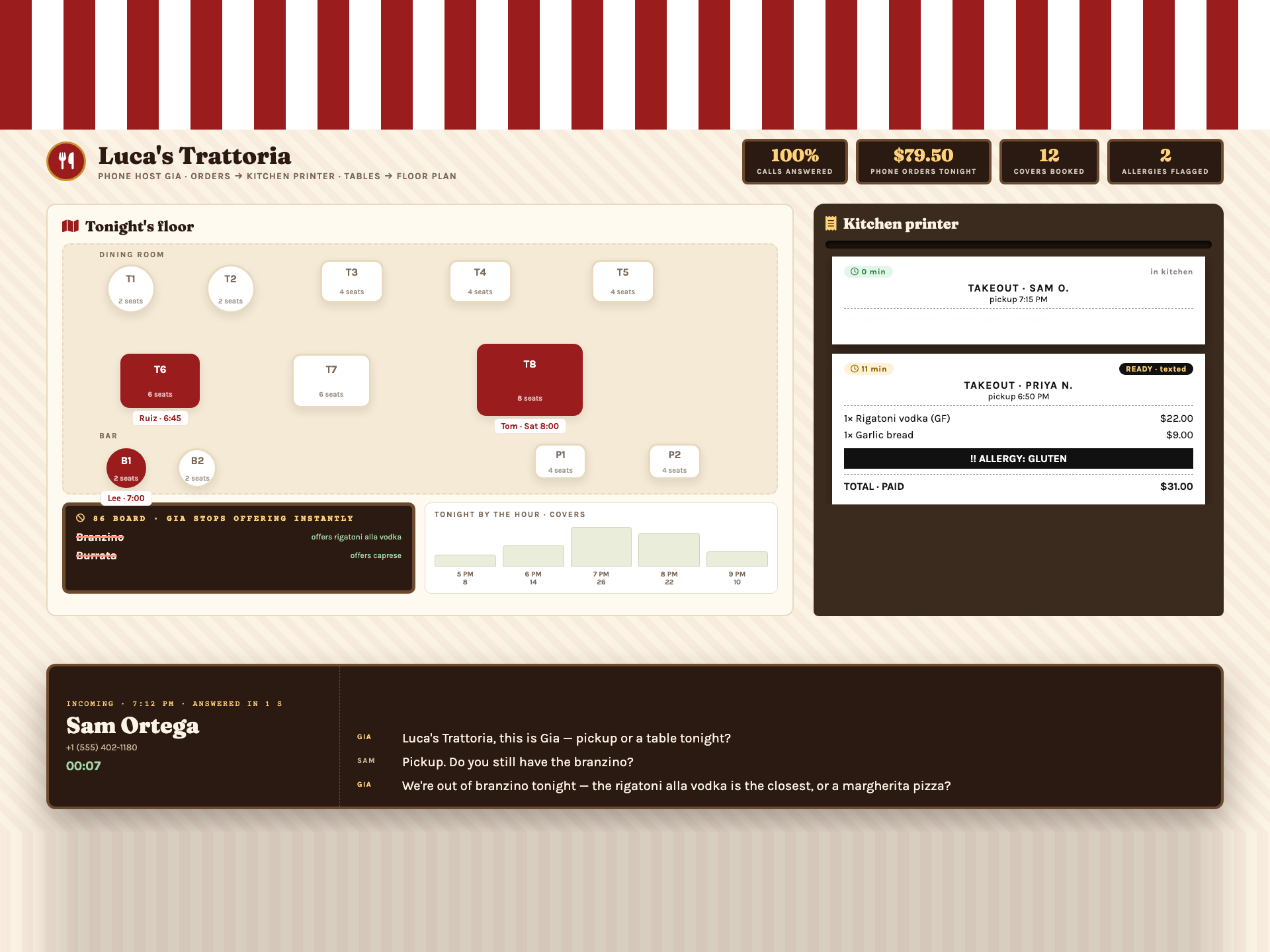
Reads the menu it's been given, takes the order, confirms the pickup time against your real prep window, and sends it through to the kitchen. No ticket written on a napkin.
Checks the book, holds the table, takes the party size and the name, and texts the confirmation. Handles the change and the cancellation later without anyone stopping service.
Answers what you've told it and nothing you haven't. The questions that eat a host's evening stop reaching the host.
When something comes off the menu the agent stops offering it. It never promises a dish the kitchen can't send.
A demo business with a real agent behind it. Talk to it the way a customer would and watch the booking land on the board.
$900 to build it — $600 as a founding client — then $450 a month with 500 call minutes included. Just need the follow-ups automated? One GoHighLevel workflow is $400. A human answering that phone costs $2,800 to $4,500 a month and goes home at five.
It reads the menu you give it, repeats the order back before confirming, and sends the ticket through. Anything it isn't sure about — a substitution, an allergy — it hands to a person rather than guessing.
It records what the guest says and flags it on the ticket, and it never tells a guest a dish is safe. Allergy questions are an explicit escalation in every restaurant agent we build.
It sits on your existing number and delivers the order the way you want it — to a tablet, a printer, an email, or straight into your system if it has an API.
Some will, and it should never be the only option. Ours offers a human the moment somebody asks. The alternative you're comparing it to isn't a person, it's the phone ringing out.
Five to seven days, including your menu, your hours, your prep times and your escalation rules. Then thirty days live with the baseline measured first.
We'll come back with what an agent can handle, what it should hand to a human, what it costs to run each month — and a demo scripted to your business within 48 hours.
Two years of GoHighLevel lead-capture and follow-up pipelines across 30+ service businesses, then seven production voice agents on Vapi and Retell. Small on purpose: you talk to the engineer who writes the code, not an account manager.
 Adel Atya