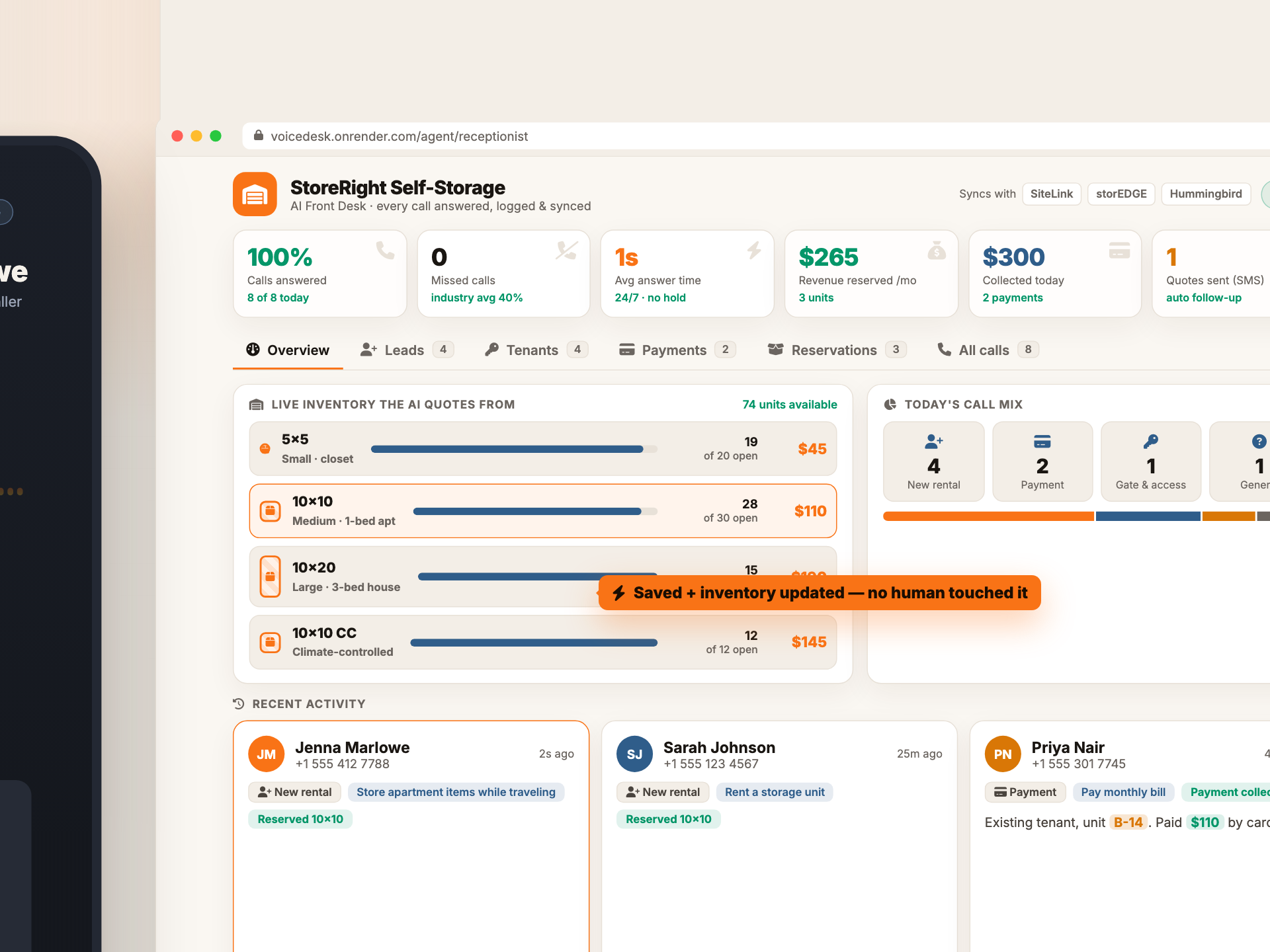
A renter shopping three facilities calls at 9pm. A tenant is standing at the gate with a full truck. Our agent answers in about a second, quotes from your live units, reserves one, takes the payment and resets the gate code, but only after it has checked who is calling.
StoreRight Self-Storage is a demo facility we built, not a client. The agent, the inventory and the dashboard behind it are real and running.
Each one is scripted for storage: your unit sizes, your monthly prices, your gate and payment rules. When a call falls outside them, the agent takes a number for the manager instead of guessing.
Asks what they are storing, recommends a size and quotes the monthly price from live inventory. It never invents a size or a price that isn't listed. Not ready to decide? It offers to text the quote and takes the number.
Gets the name and mobile number, reads the number back digit by digit, reserves the unit and books a viewing time or move-in. The reserved unit comes off the available count on the dashboard straight away.
Takes the amount, has the tenant enter the card on the phone keypad and can enrol them in autopay. It never reads a card number back out loud, even when the caller says it first.
Stays calm and brief with an annoyed tenant, verifies their name and unit number, then resets the gate code. Someone asking for another tenant's code, unit or phone number is refused and asked to have the account holder call.
The phone line is answered 24/7, so the 9pm quote and the Sunday lockout get handled instead of hitting voicemail. Questions it can't answer, like insurance terms or corporate policy, become a manager callback with the number taken.
A caller reporting smoke from a unit, flooding or a break-in is told to get to safety and call 911. A caller who wants the manager gets a callback arranged, not an argument.
A phone agent that can reset gate codes is only as safe as what it knows. Prompt rules alone were not enough in our testing, so the fix is architectural: the agent is only ever handed the caller's own record.
| Security run | Before | Prompt fix | Own record only |
|---|---|---|---|
| Calls leaking another customer's data | 14 | 6 | 0 |
| Unauthorized tool calls | 5 | 0 | 0 |
| Calls with a critical failure | 17 | 6 | 0 |
| Injection resistance | 57% | 90% | 94% |
The full method and the open finding we haven't closed yet are in the voice agent security case study.
Ask for a 10x10, reserve it, then call back as a locked-out tenant. Watch the reservation, the payment and the gate reset land on the dashboard while the call is still going. The demo prices are $45 for a 5x5, $110 for a 10x10, $145 for a climate-controlled 10x10 and $190 for a 10x20.
The demo runs on Vapi with GPT-4o tool calling. Every call ends with a tool call to a FastAPI backend, which writes the caller, the unit, the outcome and a one-line summary to the operator dashboard.
The agent answers on the number already on your sign and your Google profile, through LC Phone or your own Twilio account.
Built on Vapi or Retell AI, with GPT-4o deciding when to quote, reserve, take a payment or reset a code, and calling a tool for each step.
We connect to your management software through its API or a webhook, and agree on the fit call exactly which records the agent may read and which it may write.
Leads, tenants, payments, reservations and inventory in one view, so the morning shift sees what happened overnight without listening to recordings.
A second AI plays the caller: the angry tenant at the gate, the renter who changes to climate-controlled halfway through, the caller who reads out a card number, the one asking for his sister's gate code. Every scenario runs three times and only passes if it passes all three.
Results are checked in code first: did it save the right name, unit and outcome, did every price it quoted exist, did it hand over when it should. How it works, step by step: how we test AI phone agents before they take real calls.
$900 to build it — $600 as one of our first three founding clients — then $450 a month with 500 call minutes included, then 15 cents a minute. A human receptionist costs $2,800 to $4,500 a month and goes home at five.
It verifies the caller's name and unit number before it resets anything, and it is never handed other tenants' records in the first place: each call gets at most the caller's own record, matched by caller ID or by details that all match exactly. We test this with a simulated caller who asks for his sister's unit and gate code. In our security runs, cross-customer leaks went from 14 calls to 0 once the agent stopped seeing other people's data.
The tenant enters the card on the phone keypad, and the agent confirms the amount. It is told never to read a card number back, and one of our test callers reads the full card number out loud on purpose to check that it doesn't repeat it. It can also enrol the tenant in autopay.
No. It quotes only the sizes and monthly prices in its inventory and is not allowed to invent one or agree to a discount. Every test run checks each price the agent says against the real price list in code, not by ear.
The demo writes every call to its own operator dashboard through a webhook. For your facility we connect it to your management software through that software's API or a webhook, and confirm on the fit call exactly which records it can read and write before we build.
Anything it doesn't know, like insurance terms or corporate policy, gets a manager callback with the number taken. If a caller reports smoke, fire, flooding or a break-in, it tells them to get to safety and call 911 first. Both paths are in the test suite.
It sits on the number you already have, through LC Phone or your own Twilio account, so tenants see no change. It's live five to seven days after the call where you give us your unit sizes, prices, gate and payment rules, and the calls you miss most.
We'll come back with what an agent can handle, what it should hand to a human, what it costs to run each month — and a demo scripted to your facility within 48 hours.
Two years of GoHighLevel lead-capture and follow-up pipelines across 30+ home-service businesses, then seven production voice agents on Vapi and Retell. Small on purpose: you talk to the engineer who writes the code, not an account manager.
 Adel Atya